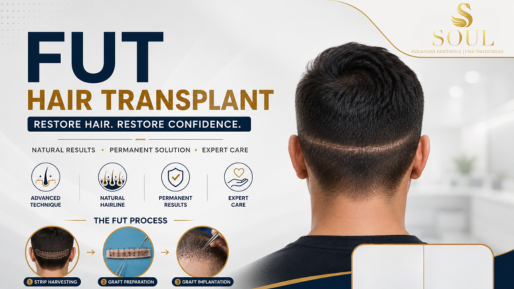
Hair loss can gradually affect your appearance and confidence, especially when thinning becomes noticeable around the hairline, temples, or crown. If you’re exploring hair restoration options, you may have come across FUT hair transplant, one of the established techniques used to restore hair in areas affected by pattern hair loss.
So, what exactly is a FUT hair transplant?
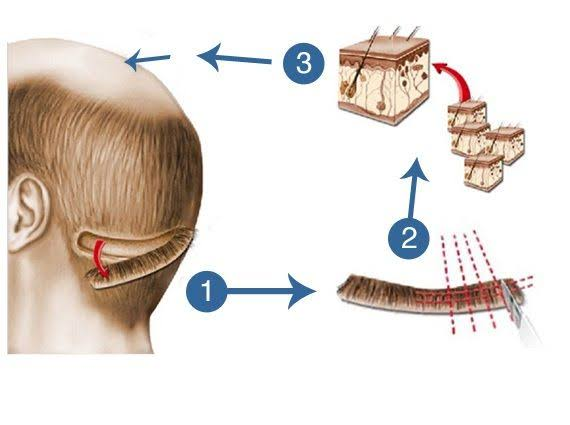
A FUT hair transplant, or Follicular Unit Transplantation, involves removing a strip of hair-bearing skin from the donor area, usually at the back or sides of the scalp. Specialists then separate the strip into individual follicular grafts and carefully place those grafts into areas experiencing hair loss.
At Soul Aesthetic in Mumbai, the focus is on selecting a hair restoration approach based on each patient’s individual hair-loss pattern, donor hair, scalp condition, and long-term goals.
In this guide, we’ll explain how FUT works, who may benefit from it, its benefits and limitations, recovery, results, FUT vs FUE, and frequently asked questions.
What Is a FUT Hair Transplant?
FUT hair transplant stands for Follicular Unit Transplantation.
Unlike FUE, where individual follicular units are extracted directly from the donor area, FUT involves removing a narrow strip of hair-bearing skin from the donor area.
The strip is carefully divided into individual follicular units under magnification. These grafts are then transplanted into areas where hair has become thin or has been lost.
The procedure generally involves three main stages:
- Harvesting the donor strip
- Preparing individual follicular grafts
- Implanting the grafts into the recipient area
The objective is to redistribute healthy hair follicles while creating natural-looking coverage.
The direction, angle, spacing, and placement of each graft are important because they influence how naturally the transplanted hair blends with your existing hair.
At Soul Aesthetic, a detailed consultation helps determine whether FUT or another hair restoration technique is suitable for your individual condition.
How Does a FUT Hair Transplant Work?
A FUT procedure follows several carefully planned steps.
1. Consultation and Hair Assessment
The process begins with an assessment of your hair and scalp.
Your specialist may evaluate:
- Hair-loss pattern
- Donor hair density
- Hair thickness
- Scalp condition
- Existing hair
- Family history of hair loss
- Previous treatments
- Future hair-loss concerns
This assessment helps determine whether you have sufficient donor hair for transplantation.
It also allows your specialist to establish realistic expectations.
2. Donor Area Preparation
The donor area is usually located at the back or sides of the scalp.
These areas often contain follicles that are more resistant to pattern hair loss.
The area is cleaned and prepared before the procedure, and local anesthesia is generally used to minimize discomfort.
3. Removal of the Donor Strip
During FUT, the specialist carefully removes a strip of hair-bearing skin from the donor area.
The size of the strip depends on the number of grafts required and the characteristics of your donor area.
The donor area is then closed, resulting in a linear scar.
4. Graft Separation
The donor strip is carefully separated into individual follicular units under magnification.
Proper handling is important to protect the follicles and prepare them for transplantation.
5. Graft Placement
The recipient area is prepared according to the treatment plan.
The specialist creates tiny openings where the grafts will be placed.
Each graft is positioned carefully according to the desired direction, angle, and density.
This is especially important around the hairline because an incorrectly designed hairline can look unnatural.
6. Recovery and Follow-Up
After the procedure, you’ll receive instructions about scalp care and recovery.
These may include guidance about:
- Washing
- Sleeping
- Physical activity
- Sun exposure
- Hair products
- Medication
- Follow-up appointments
Following these instructions carefully can support proper healing.
Who Is a Good Candidate for FUT Hair Transplant?
Not everyone experiencing hair loss is automatically suitable for FUT.
A professional consultation is important because your specialist needs to evaluate your donor area, hair-loss pattern, scalp health, and expectations.
You may be a potential candidate if you have:
- Pattern hair loss
- Sufficient donor hair
- A healthy scalp
- A stable or reasonably predictable hair-loss pattern
- Realistic expectations
- A need for significant graft coverage
FUT may be particularly useful for some patients who require a larger number of grafts and have adequate donor density.
However, FUT isn’t suitable for everyone.
Patients with limited donor hair, certain scalp conditions, or unrealistic expectations may require a different approach.
Your specialist can recommend the most appropriate option after evaluating your individual condition.
Is FUT Hair Transplant Better Than FUE?
Short answer: Neither technique is universally better.
FUT may be suitable for patients who require a larger number of grafts and have sufficient donor density. FUE may be preferred by patients who want individual follicle extraction and want to avoid a linear donor scar.
The appropriate technique depends on factors such as:
- Hair-loss pattern
- Donor density
- Hair characteristics
- Scalp condition
- Treatment goals
- Long-term expectations
Therefore, it’s better to choose a technique based on professional assessment rather than simply following online comparisons.
What Are the Benefits of FUT Hair Transplant?
A FUT hair transplant can provide several potential benefits for appropriately selected patients.
Larger Graft Harvesting Potential
FUT can allow specialists to obtain a substantial number of grafts during a session.
This can be useful for patients who need significant hair coverage.
However, the number of grafts should always depend on the quality and availability of the donor area.
Efficient Graft Harvesting
Because the donor strip contains multiple follicular units, specialists can efficiently prepare grafts for transplantation.
Natural-Looking Hair Growth
Careful hairline planning and graft placement can help transplanted hair blend naturally with existing hair.
The goal isn’t simply to add as many grafts as possible.
Instead, the focus should remain on appropriate density and natural hair direction.
Suitable for Certain Hair-Loss Patterns
Some patients with extensive hair loss may benefit from a technique that can provide a larger number of grafts.
However, suitability depends on the patient’s individual donor area and long-term hair-loss pattern.
FUT vs FUE Hair Transplant: What’s the Difference?
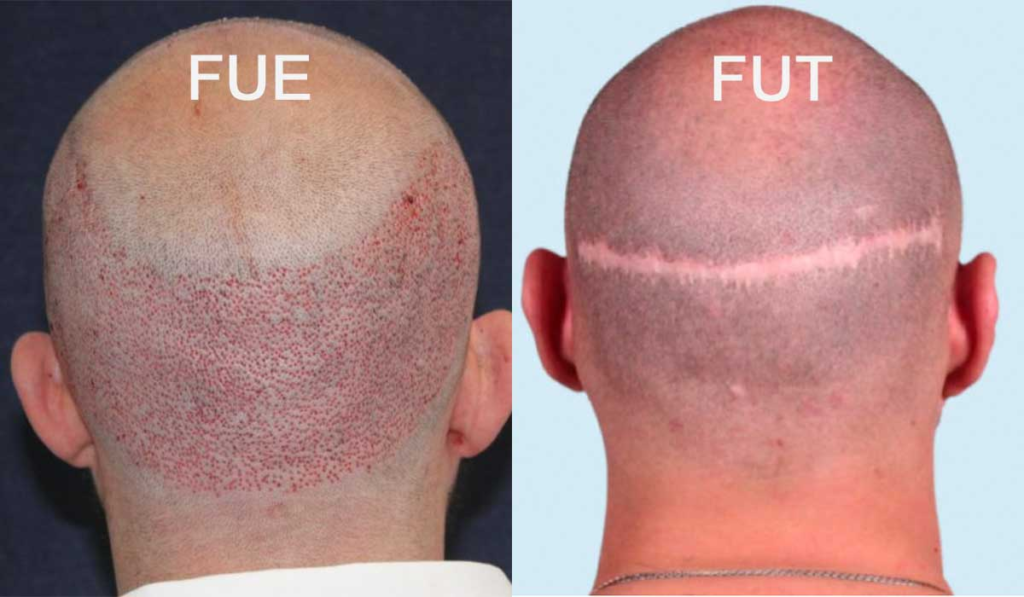
Both FUT and FUE aim to move healthy hair follicles from a donor area to areas affected by hair loss.
The main difference is how the follicles are harvested.
| Feature | FUT | FUE |
| Harvesting method | Removes a strip of donor skin | Extracts individual follicular units |
| Donor-area scarring | Linear scar | Multiple small scars |
| Graft harvesting | Can be useful for larger sessions | Individual follicle extraction |
| Recovery | May involve longer donor-area recovery | Often shorter donor-area recovery |
| Best option | Depends on patient suitability | Depends on patient suitability |
FUT may be appropriate for some patients who require a larger number of grafts.
FUE may be preferred for patients who want to avoid a linear scar.
Neither option should be considered universally superior.
What Is FUT Hair Transplant Recovery Like?
Recovery happens gradually, and your experience may differ depending on the number of grafts, your healing response, and the aftercare instructions provided by your specialist.
First Week
During the first week, your scalp begins healing.
You may experience:
- Redness
- Mild swelling
- Tenderness
- Scabbing
- Tightness around the donor area
These effects are generally temporary, but your specialist should guide you through your individual recovery.
First Month
The donor area continues healing.
You may also notice shedding of transplanted hair.
This can be concerning, but temporary shedding can occur as transplanted follicles adjust to their new growth cycle.
3–4 Months
Early new hair growth may begin.
The new hairs can initially look fine or thin.
Don’t expect full density at this stage because the follicles require time to mature.
6–9 Months
Hair growth usually becomes more noticeable.
The transplanted hair can gradually become:
- Thicker
- Longer
- Stronger
- More visible
12–18 Months
The transplanted hair continues to mature.
Many patients can see a much more developed outcome during this period, although the exact timeline varies from person to person.
What Results Can You Expect From FUT Hair Transplant?
The goal of hair transplantation is to create natural-looking hair growth in areas affected by hair loss.
Depending on your individual condition, you may notice improvements in:
- Hairline definition
- Scalp coverage
- Hair density
- Facial balance
- Overall appearance
However, FUT hair transplant results vary between patients.
Your outcome can depend on:
- Donor hair quality
- Hair thickness
- Number of grafts
- Hair-loss pattern
- Genetics
- Healing response
- Age
- Aftercare
A hair transplant also doesn’t necessarily stop future hair loss.
Transplanted follicles can continue growing, while existing non-transplanted hair may continue to thin depending on your genetics and underlying condition.
FUT Hair Transplant Before and After
Before-and-after photographs can help you understand what a hair restoration transformation may look like.
However, you should always view these photographs as examples rather than guarantees.
Every patient’s starting point is different.
Some patients may need a smaller number of grafts to restore a receding hairline, while others may require broader scalp coverage.
Suggested image placement:
Image: FUT hair transplant before-and-after comparison
Caption: Hair restoration results develop gradually as transplanted follicles grow and mature over several months.
ALT text: FUT hair transplant before and after showing improved hairline and scalp coverage.
For more information about the transformation process, read Hair Transplant Before and After.
What Are the Possible FUT Hair Transplant Side Effects?
Like any medical procedure, FUT can involve temporary side effects.
Common effects may include:
- Redness
- Swelling
- Mild discomfort
- Scabbing
- Tightness around the donor area
- Temporary numbness
- Temporary shedding
One important difference between FUT and FUE is donor-area scarring.
FUT creates a linear scar because a strip of skin is removed. Its visibility can depend on healing, surgical closure, individual scar formation, and hair length.
Before treatment, your specialist should explain potential risks and recovery expectations.
For more information, read Hair Transplant Side Effects.
How to Get Better FUT Hair Transplant Results
Your specialist plays an important role, but your actions during recovery also matter.
Follow Your Aftercare Instructions
Follow the instructions provided by your medical team carefully.
These instructions help protect the transplanted grafts and support the healing process.
Protect Your Scalp
Avoid unnecessary direct sunlight during the early recovery period.
Your specialist can tell you when you can safely return to normal outdoor activities.
Avoid Scratching
Scabbing can occur during recovery.
Avoid scratching or picking the treated area because this can irritate your scalp and interfere with healing.
Avoid Strenuous Exercise Initially
Your specialist may recommend limiting strenuous physical activity for a certain period.
Follow their specific instructions rather than returning to intense exercise too quickly.
Maintain a Balanced Diet
A balanced diet containing adequate protein, vitamins, minerals, and other nutrients can support overall hair health.
If you have a nutritional deficiency, speak with a healthcare professional before taking supplements.
Attend Follow-Up Appointments
Follow-up appointments allow your specialist to monitor your healing and hair growth and address any concerns during your recovery.
Is FUT Hair Transplant Permanent?
A common question is whether the results of a FUT hair transplant can last permanently.
The transplanted follicles are generally selected from areas that are more resistant to pattern hair loss. Once successfully transplanted and established, these follicles can continue producing hair for many years.
However, permanent doesn’t mean that every strand of hair on your scalp will remain unchanged forever.
Existing non-transplanted hair can continue to thin because of genetics, age, or other factors.
FUT Hair Transplant in Mumbai: Choosing the Right Clinic
If you’re considering a FUT hair transplant in Mumbai, choosing the right clinic is an important part of your hair restoration journey.
Don’t make your decision based only on price or the number of grafts offered.
Instead, consider whether the clinic provides:
- Proper hair and scalp assessment
- Personalized treatment planning
- Clear explanation of the procedure
- Realistic expectations
- Appropriate aftercare
- Follow-up support
- Transparent information about potential risks
At Soul Aesthetic, patients can discuss their hair-loss concerns and understand which hair restoration approach may be suitable for their individual needs.
The goal should always be to select treatment based on your hair-loss condition rather than simply choosing the most popular technique.
FUT Hair Transplant: Myths vs Facts
Myth 1: FUT Gives Immediate Hair Growth
Fact: Hair growth takes time. New growth generally develops gradually over several months.
Myth 2: FUT Is Always Better Than FUE
Fact: Neither technique is universally better. The right option depends on your individual hair-loss condition and treatment goals.
Myth 3: Hair Transplant Stops All Future Hair Loss
Fact: Existing non-transplanted hair may continue thinning due to genetics and other factors.
Myth 4: FUT Doesn’t Leave a Scar
Fact: FUT creates a linear donor-area scar because a strip of skin is removed.
Myth 5: More Grafts Always Mean Better Results
Fact: Proper planning, graft quality, placement, and donor-area management are more important than simply increasing the number of grafts.
Myth 6: Everyone Gets the Same Results
Fact: Results vary depending on donor hair, genetics, healing, hair characteristics, and aftercare.
Why Choose Soul Aesthetic for Hair Transplant Treatment?
Choosing a hair transplant clinic is an important decision.
At Soul Aesthetic, the focus is on understanding each patient’s individual hair-loss condition and creating a treatment approach based on their specific needs.
Personalized Hair Assessment
Your hair loss isn’t identical to someone else’s.
A personalized assessment helps your specialist understand your donor area, hair-loss pattern, scalp condition, and treatment goals.
Natural-Looking Hairline Planning
A natural hairline requires careful planning.
Factors such as facial proportions, existing hair, age, and potential future hair loss should be considered when creating the treatment plan.
Patient-Focused Care
Patients should understand their treatment before making a decision.
At Soul Aesthetic, the treatment journey focuses on explaining the procedure, recovery, potential risks, expected timeline, and realistic outcomes.
Focus on Long-Term Results
Hair transplantation isn’t simply about adding hair today.
The treatment should also consider your future hair-loss pattern and long-term appearance.
Before deciding on treatment, you can also learn more about Is Hair Transplant Safe.
To learn more about Soul Aesthetic and its approach to patient care, visit About Us.
Conclusion
A FUT hair transplant can be an effective hair restoration option for carefully selected patients with suitable donor hair. The procedure involves harvesting a strip of healthy donor skin, separating it into individual follicular grafts, and placing those grafts into areas affected by hair loss. However, choosing FUT should not depend only on the number of grafts or promises of quick results. Factors such as donor hair, hair-loss pattern, scalp health, age, genetics, expectations, and long-term goals all play an important role.
Hair restoration takes time, with initial healing occurring within weeks, early new growth often beginning around three to four months, and hair continuing to mature over the following months. At Soul Aesthetic, the focus is on personalized assessment, careful treatment planning, natural-looking hairline design, and appropriate follow-up care. If you’re considering a FUT hair transplant in Mumbai, a professional consultation can help determine whether the treatment is suitable for you.
You can Contact Us to discuss your hair restoration goals.
Q1. What is a FUT hair transplant?
Ans. FUT, or Follicular Unit Transplantation, removes a strip of hair-bearing skin from the donor area. Specialists divide it into individual follicular grafts and transplant them to areas affected by hair loss.
Q2. Is FUT better than FUE?
Ans. Neither technique is automatically better. Your specialist should recommend the appropriate option based on your donor hair, hair-loss pattern, goals, and overall suitability.
Q3. How long does FUT recovery take?
Ans. Initial healing takes days to weeks, while complete hair growth takes much longer. New growth may begin after a few months, with mature results taking around 12 months or longer.
Q4. Does FUT leave a scar?
Ans. Yes. FUT leaves a linear donor-area scar. Its visibility varies depending on healing, scar formation, surgical technique, and hair length.
Q5. When does hair grow after FUT?
Ans. New hair growth often begins around three to four months after treatment. Hair gradually becomes thicker over the following months.
Q6. Is FUT painful?
Ans. Local anesthesia is generally used during the procedure to minimize discomfort. Some soreness or tightness may occur during recovery.
Q7. Are FUT hair transplant results permanent?
Ans. Transplanted follicles can provide long-lasting hair growth because they are generally selected from areas more resistant to pattern hair loss. However, existing hair can continue thinning.
Q8. How many grafts can FUT provide?
Ans. The number depends on your donor density, scalp characteristics, hair-loss pattern, and treatment goals. Your specialist can determine an appropriate number during your consultation.
Q9. How much does a FUT hair transplant cost in Mumbai?
Ans. The cost varies according to the number of grafts, treatment requirements, clinic, and individual case. A consultation is the best way to receive an accurate estimate.
Q10. Is FUT suitable for everyone?
Ans. No. Your donor hair, scalp health, hair-loss pattern, medical history, and expectations all influence whether FUT is suitable for you.