
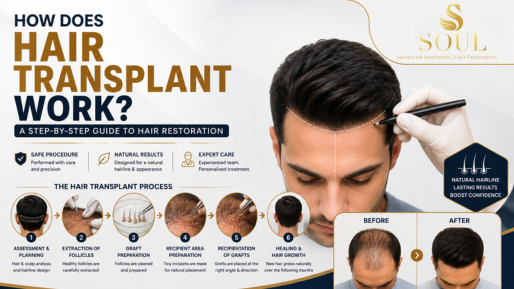
If you are experiencing hair thinning, a receding hairline, or bald patches, you may have wondered: how does hair transplant work?
A hair transplant works by moving healthy hair follicles from a donor area, usually the back or sides of the scalp, to areas affected by hair loss. The follicles are carefully extracted, prepared, and implanted into the recipient area, where they can gradually grow new hair.
Unlike a wig or temporary hair replacement system, a hair transplant uses your own hair follicles. The goal is not simply to add hair, but to create a natural-looking hairline, improve coverage, and make effective use of the available donor hair.
If you are considering a hair transplant in Andheri, Mumbai, understanding how the procedure works can help you make a more informed decision before choosing a clinic.
How Does Hair Transplant Work?
A hair transplant works by relocating healthy hair follicles from a stable donor area to areas where hair has become thin or has been lost. The follicles are extracted, prepared, and carefully implanted according to your hairline, existing hair, donor supply, and desired coverage.
A hair transplant generally involves four main stages:
- Assessment and treatment planning
- Extraction of healthy hair follicles
- Preparation of the recipient area
- Implantation of the hair grafts
The transplanted follicles are positioned according to your existing hair pattern, hairline, density requirements, donor supply, and degree of hair loss.
The basic principle is simple: healthy follicles are relocated from a suitable donor region to areas affected by hair loss.
However, the quality of the result depends on more than simply moving follicles. Donor management, graft handling, hairline design, implantation angle, spacing, surgical expertise, and long-term hair-loss planning can all influence the outcome.
Where Does the Hair for a Transplant Come From?
The hair used for transplantation usually comes from the donor area, most commonly the back and sides of the scalp.
These areas are often more resistant to the pattern of hair loss that affects the top of the scalp. Because of this, suitable follicles from the donor area may continue growing after transplantation.
The hair is transferred as small units called grafts. A graft may contain one, two, three, or sometimes more hair follicles.
Your specialist determines how these grafts should be distributed according to the areas requiring restoration.
For example:
- Single-hair grafts can help create a natural-looking front hairline.
- Two-hair grafts can help transition into the central region.
- Larger grafts can contribute to density farther behind the hairline.
Careful distribution helps avoid an artificial or overly dense appearance.
Step-by-Step: How Does Hair Transplant Work?
Step 1: Hair and Scalp Assessment
The process begins before the actual procedure.
A qualified hair-restoration specialist evaluates several factors, including:
- Pattern and extent of hair loss
- Hairline recession
- Donor-area density
- Hair thickness and characteristics
- Scalp condition
- Existing miniaturized hairs
- Expected future hair loss
- Available donor grafts
- Your treatment expectations
This assessment is important because not everyone experiencing hair loss is automatically a suitable candidate for transplantation.
A good treatment plan should consider both your current hair loss and the possibility of future thinning.
If your hair loss has another underlying cause, your specialist may recommend addressing that issue before considering transplantation.
Step 2: Designing the Hairline
Hairline design is one of the most important parts of a hair transplant.
A natural hairline is usually not a perfectly straight line. It contains subtle irregularities, transitional zones, and different hair densities.
Your specialist may consider:
- Age
- Facial proportions
- Existing hairline
- Donor availability
- Hair-loss pattern
- Hair characteristics
- Long-term appearance
The objective is to create a hairline that looks natural and complements your facial features.
A hairline that looks attractive immediately after surgery may not necessarily be the best long-term design if future hair loss has not been considered.
For this reason, long-term planning is an important part of hair restoration.
Step 3: Preparing the Donor Area
Before extraction, the scalp is cleaned and the donor area is prepared.
Local anesthesia is generally used so that the treatment area is numb during the procedure.
The donor area is carefully assessed and mapped so that follicles can be harvested appropriately while preserving the remaining donor hair.
This is particularly important because donor hair is a limited resource.
A good hair transplant is therefore not simply about extracting as many grafts as possible. It is about using the available donor supply strategically.
Step 4: Extracting the Hair Grafts
There are two commonly used hair transplant harvesting techniques: FUE and FUT.
What Is FUE Hair Transplant?
FUE stands for Follicular Unit Extraction.
With FUE, individual follicular units are extracted from the donor area using a small punch instrument. The extracted grafts are then prepared for implantation.
Because individual grafts are extracted rather than removing a strip of scalp, FUE does not create the linear donor scar associated with FUT.
FUE can be suitable for many patients, but it is still a surgical procedure. The quality of the result depends on appropriate patient selection, careful extraction, graft handling, and implantation.
What Is FUT Hair Transplant?
FUT stands for Follicular Unit Transplantation.
In FUT, a strip of hair-bearing scalp is removed from the donor area. The strip is then carefully divided into individual follicular grafts, which are subsequently implanted into the recipient area.
FUT can be useful for selected patients, particularly when a significant number of grafts are required.
However, FUT creates a linear scar in the donor area.
The choice between FUE and FUT should be based on your donor characteristics, hair-loss pattern, treatment goals, and professional assessment rather than simply choosing the technique that sounds newer.
Step 5: Preparing the Bald or Thinning Area
Once the grafts are ready, attention turns to the recipient area.
The specialist creates tiny recipient sites at carefully planned angles and directions.
This is where precision becomes particularly important.
Hair does not naturally grow straight upward from the scalp. Its angle and direction vary across different areas of the scalp.
The specialist therefore aims to replicate your natural growth pattern when positioning the grafts.
Poorly planned angles or inappropriate density can make transplanted hair look unnatural even when the grafts themselves survive.
Step 6: Implanting the Hair Grafts
The prepared grafts are then carefully placed into the recipient sites.
The specialist considers:
- Hair direction
- Growth angle
- Graft size
- Density
- Spacing
- Hairline transition
- Existing native hair
The goal is to make the transplanted follicles blend naturally with your existing hair.
This is why a successful hair transplant should be viewed as hairline and density reconstruction, rather than simply putting hair into bald areas.
Step 7: What Happens Immediately After a Hair Transplant?
After the procedure, your scalp may show temporary redness, swelling, crusting, or sensitivity.
Your clinic will provide specific instructions for:
- Washing your scalp
- Sleeping position
- Physical activity
- Scalp care
- Sun exposure
- Hair products
- Follow-up appointments
It is important to follow your specialist’s instructions carefully because the newly transplanted grafts need time to settle and the scalp needs time to heal.
The initial appearance should not be considered the final result.
In fact, the early post-transplant appearance can look very different from the eventual outcome.
Does Transplanted Hair Fall Out After Surgery?
Yes, transplanted hair can temporarily shed after the procedure.
This can be concerning for patients who expect immediate and permanent hair growth, but temporary shedding can occur during the normal post-transplant growth cycle.
The important part is the follicle beneath the skin.
After the healing and resting phases, transplanted follicles can begin producing new hair.
This is why evaluating a hair transplant only a few weeks after surgery can give a misleading impression of the final result.
To understand the expected transformation in more detail, explore Hair Transplant Before and After.
When Does New Hair Start Growing After a Hair Transplant?
Hair growth takes time.
The transplanted follicles need to heal and progress through their natural growth cycle before noticeable new growth develops.
Results therefore appear gradually rather than overnight.
A simplified timeline may look like this:
First Few Weeks
The scalp begins healing. Temporary changes such as redness, swelling, or crusting may occur, and some transplanted hair shafts may shed.
Around 3–4 Months
Early new hair growth may begin becoming noticeable in some patients.
Around 6 Months
More visible improvement in coverage and density may develop.
Around 9–12 Months
The result generally becomes much more apparent, although growth can continue beyond this period.
Around 12–18 Months
Hair can continue maturing, thickening, and improving depending on the individual.
The exact timeline varies from patient to patient.
Why Does a Hair Transplant Work?
The key is the behaviour of the transplanted follicle.
A hair transplant does not create brand-new follicles. Instead, it relocates existing healthy follicles.
When appropriate donor follicles are moved into areas affected by pattern hair loss, they can continue producing hair in their new location after healing.
This is why donor selection is so important.
If too many grafts are removed, the donor area may become visibly depleted. If unsuitable follicles are selected, the long-term result may be less satisfactory.
Strategic donor management is therefore an important part of responsible hair restoration.
Who Is a Good Candidate for a Hair Transplant?
A hair transplant may be considered for people experiencing permanent hair loss who have sufficient healthy donor hair and realistic expectations.
Potential candidates may include people with:
- Male pattern hair loss
- Female pattern hair loss in selected cases
- Receding hairlines
- Thinning crown areas
- Certain stable bald patches
- Hair loss caused by trauma or scarring in appropriately selected cases
However, diagnosis comes first.
Hair loss can have different causes, and transplantation may not be appropriate if the underlying condition is temporary, uncontrolled, or likely to cause continued severe hair loss.
A professional consultation helps determine whether transplantation is appropriate for your situation.
What Factors Affect Hair Transplant Results?
Two patients can undergo similar procedures and achieve different outcomes.
Several factors can influence the final result.
1. Donor Hair Quality
A strong donor supply provides more options for hair restoration.
2. Hair Characteristics
Hair thickness, texture, curl, and contrast with the scalp can influence how dense the transplanted area appears.
3. Extent of Hair Loss
More advanced hair loss generally requires more strategic donor allocation.
4. Hairline Design
A poorly designed hairline can make an otherwise technically successful transplant look unnatural.
5. Graft Survival
Careful extraction, storage, handling, and implantation are important for protecting graft viability.
6. Surgical Technique
Precision during extraction and implantation can influence the overall result.
7. Future Hair Loss
Continued thinning of native hair can change the appearance of the transplant over time.
8. Aftercare
Following post-operative instructions helps support proper healing.
FUE vs FUT: Which Hair Transplant Method Is Better?
There is no single technique that is automatically best for every patient.
| Feature | FUE | FUT |
| Extraction | Individual follicular units | Strip of scalp |
| Donor-area scarring | Multiple small scars | Linear scar |
| Graft preparation | Individual extraction | Grafts dissected from strip |
| Suitability | Depends on individual factors | Useful in selected cases |
| Best choice | Determined during consultation | Determined during consultation |
The right technique should be selected after examining your scalp, donor area, hair-loss pattern, and treatment goals rather than choosing based solely on advertisements or procedure names.
How Long Does a Hair Transplant Take?
The duration depends on factors such as:
- Number of grafts
- Technique being used
- Extent of hair loss
- Complexity of the procedure
- Individual treatment plan
A smaller procedure may take considerably less time than a larger session involving extensive restoration.
Your specialist should explain the expected procedure duration after assessing your individual requirements.
Is Hair Transplant Safe?
Hair transplantation is a surgical procedure and, like other procedures, can involve potential risks and side effects.
These may include:
- Swelling
- Redness
- Temporary discomfort
- Scabbing
- Changes in sensation
- Scarring
- Infection
- Graft-related complications
Your individual risk can depend on your health, treatment plan, technique, and other factors.
Understanding these considerations before treatment can help you make a more informed decision.
For a detailed guide, read Is Hair Transplant Safe.
You can also learn about potential recovery-related effects in our guide to Hair Transplant Side Effects.
Why Do People Consider Soul Aesthetic for a Safe Hair Transplant?
Choosing the right clinic is an important decision when considering a hair transplant. Patients should look beyond price and graft numbers and consider the overall quality of treatment and care.
At Soul Aesthetic, patients can consider the clinic for hair restoration based on:
- Personalized Assessment: Your hair-loss pattern, donor hair availability, scalp condition, and restoration goals are evaluated before treatment planning.
- Individualized Treatment Planning: The recommended hair transplant approach is based on your specific requirements rather than using the same technique for every patient.
- Natural-Looking Hairline Design: Careful planning of the hairline, graft placement, direction, and density helps support a natural-looking appearance.
- Focus on Donor Hair: Available donor hair is assessed and planned strategically to support both current restoration needs and long-term results.
- Clear Expectations: Patients can discuss expected growth, recovery, potential limitations, and realistic outcomes before proceeding.
- Post-Operative Guidance: Proper aftercare and follow-up support help patients understand the recovery process and care for their scalp after treatment.
- Mumbai Location: If you’re looking for a hair transplant in Andheri, Mumbai, you can learn more about Soul Aesthetic and its approach to hair restoration.
For personalized guidance about your hair-loss concerns, contact Soul Aesthetic to discuss your treatment options.
Conclusion
So, how does a hair transplant work? A hair transplant involves moving suitable hair follicles from a donor area, usually the back or sides of the scalp, to areas affected by hair loss. The follicles are carefully extracted, prepared, and implanted according to the patient’s hairline, existing hair, donor supply, and desired coverage.
The results develop gradually as the transplanted follicles go through their natural growth cycle. While factors such as donor hair, hair-loss pattern, technique, graft handling, and aftercare can influence the outcome, proper assessment and personalized treatment planning are essential for achieving natural-looking results.
If you are considering a hair transplant in Andheri, Mumbai, don’t choose a clinic based only on price or the number of grafts promised. A professional evaluation can help determine whether hair transplantation is suitable for you and which approach may best match your long-term goals.
Q1. How does a hair transplant work?
Ans. A hair transplant moves healthy hair follicles from a suitable donor area to areas affected by hair loss. The transplanted follicles can then grow hair in their new location.
Q2. Does a hair transplant use your own hair?
Ans. Yes. Hair transplantation generally uses your own healthy hair follicles from a suitable donor area.
Q3. How long does it take to see hair transplant results?
Ans. Early growth may become noticeable after around 3–4 months, while fuller results can develop gradually over 9–18 months.
Q4. Is a hair transplant permanent?
Ans. Transplanted follicles can provide long-lasting hair growth, but your existing non-transplanted hair may continue to thin over time. Learn more about Is Hair Transplant Permanent.
Q5. Is FUE better than FUT?
Ans. Neither technique is automatically better for everyone. The appropriate method depends on your donor hair, hair-loss pattern, treatment goals, and professional assessment.
Q6. Is hair transplant safe?
Ans. Hair transplantation is a surgical procedure and can involve risks and side effects. A professional consultation can help determine whether it is suitable for you and explain the potential risks before treatment.