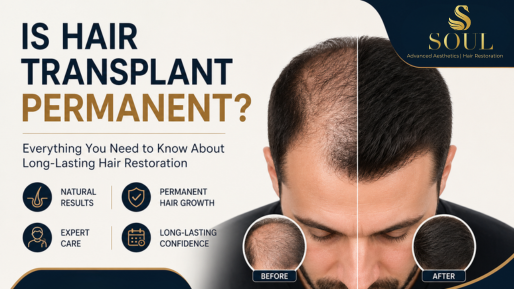
Hair loss is a common concern that affects both men and women. Whether it’s caused by genetics, age, hormonal changes, or other factors, losing hair can impact your confidence and self-esteem. Fortunately, modern hair restoration techniques have made it possible to regain natural-looking hair, and one of the most trusted solutions is a hair transplant. However, before deciding on the procedure, one question comes to almost everyone’s mind: Is Hair Transplant Permanent?
The simple answer is yes. A hair transplant is considered a long-lasting solution because healthy hair follicles are taken from areas of the scalp that are naturally resistant to hair loss. Once these follicles are transplanted successfully, they continue to grow in their new location. However, several factors influence how successful and long-lasting your results will be.
At Soul Aesthetic, we believe that every patient deserves honest advice, personalized treatment, and realistic expectations. Our experienced specialists carefully evaluate your hair loss pattern, donor hair quality, scalp health, and future hair goals before recommending the most suitable treatment. This personalized approach helps achieve natural-looking and long-lasting results.
In this guide, you’ll learn whether a hair transplant is truly permanent, how the procedure works, what affects its longevity, and why choosing the right clinic plays an important role in your hair restoration journey.
Is Hair Transplant Permanent?
Yes, a hair transplant is generally permanent because the transplanted hair follicles are taken from the permanent donor area of your scalp, where the hair is naturally resistant to pattern baldness. Once these follicles heal and begin growing in the recipient area, they continue to produce hair naturally for many years. At Soul Aesthetic, our specialists use advanced hair transplant techniques and personalized treatment plans to help patients achieve natural-looking, long-lasting hair restoration results.
Although the transplanted hair is considered permanent, it’s important to understand that your existing non-transplanted hair may continue to thin over time due to genetics, aging, or hormonal changes. This is why proper treatment planning is essential to achieve balanced and natural-looking results.
Every patient’s hair loss journey is unique. During your consultation at Soul Aesthetic, our specialists evaluate your scalp, donor hair, and long-term hair loss pattern to recommend the most suitable treatment plan based on your individual needs.
How Does a Hair Transplant Work?
Understanding how the procedure works makes it easier to understand why a hair transplant is considered permanent.
A hair transplant is a surgical procedure that involves moving healthy hair follicles from one part of the scalp, known as the donor area, to areas experiencing hair thinning or baldness, known as the recipient area. Since the transplanted follicles retain their original genetic characteristics, they continue growing even after being relocated.
Modern hair transplant techniques are designed to restore hair naturally while preserving the health of both the donor and recipient areas.
Donor Area
The donor area is usually located at the back and sides of the scalp.
Hair in these areas is naturally resistant to Dihydrotestosterone (DHT), the hormone primarily responsible for male and female pattern baldness. Because these follicles are genetically stronger, they continue growing even after transplantation.
Choosing healthy donor follicles is one of the most important factors in achieving successful, long-lasting results.
Recipient Area
The recipient area is where hair has become thin or completely absent.
During the procedure, each follicle is carefully implanted to match your natural hair direction, density, and hairline. Proper placement ensures that the final results look natural and blend seamlessly with your existing hair.
FUE Hair Transplant
Follicular Unit Extraction (FUE) is one of the most advanced and commonly performed hair transplant techniques.
In this method:
- Individual hair follicles are extracted from the donor area.
- Tiny incisions are made in the recipient area.
- Each follicle is implanted carefully to create a natural hairline.
- There is no large linear scar.
- Recovery is generally quicker compared to traditional methods.
FUE is popular because it offers natural-looking results with minimal downtime.
FUT Hair Transplant
Follicular Unit Transplantation (FUT), also known as the strip method, involves removing a thin strip of scalp from the donor area.
The strip is divided into individual follicular units, which are then implanted into the recipient area.
FUT may be recommended for patients who require a larger number of grafts or have specific hair restoration goals.
Your specialist will recommend the most suitable technique after evaluating your scalp and hair loss pattern.
Choosing the Right Technique
Both FUE and FUT have their advantages. The right option depends on several factors, including:
- Your degree of hair loss
- Donor hair density
- Scalp condition
- Hair restoration goals
- Lifestyle and recovery preferences
At Soul Aesthetic, every treatment plan is personalized to help achieve the most natural and long-lasting outcome.
If you’re also wondering whether the procedure is safe, we recommend reading our detailed guide on Is Hair Transplant Safe.
Hair Growth After Transplant
Many patients expect immediate results after a hair transplant, but hair restoration is a gradual process. If you’re wondering Is Hair Transplant Permanent, understanding the hair growth timeline can help you set realistic expectations and feel more confident throughout your recovery.
Here’s what you can typically expect after the procedure:
| Timeline | What Happens |
| 2–4 Weeks | The transplanted hair may shed temporarily. This is called shock loss and is a normal part of the healing process. |
| 3–4 Months | New hair begins to grow from the transplanted follicles. The hair may appear fine at first but gradually becomes thicker. |
| 6–9 Months | Hair density continues to improve, and the transplanted area starts looking fuller and more natural. |
| 12–18 Months | Most patients achieve their final results, with healthy, natural-looking hair that can be cut, washed, and styled like normal hair. |
The speed of hair growth varies from person to person and depends on factors such as genetics, healing ability, overall health, and aftercare. Patience is essential because the transplanted follicles need time to settle and enter their natural growth cycle.
Why Professional Expertise Matters
A successful hair transplant is not just about moving hair follicles from one area to another. It requires careful planning, artistic precision, and medical expertise to achieve natural-looking, long-lasting results.
Choosing an experienced clinic significantly improves the chances of a successful outcome because every stage of the procedure is performed with accuracy and attention to detail.
Personalized Hairline Design
Your hairline plays a major role in your overall appearance.
At Soul Aesthetic, our specialists design a hairline that complements your facial features, age, and future hair loss pattern. This ensures that your results continue to look natural for years to come.
Proper Graft Handling
Hair follicles are delicate and must be handled carefully throughout the procedure.
Our specialists use advanced techniques to protect the grafts during extraction and implantation, helping maximize graft survival and healthy hair growth.
Customized Treatment Planning
No two patients experience hair loss in the same way.
Before recommending a treatment, we evaluate:
- Hair loss pattern
- Donor hair quality
- Scalp condition
- Medical history
- Long-term goals
This allows us to create a personalized treatment plan that delivers the best possible results.
Comprehensive Patient Care
At Soul Aesthetic, our care doesn’t end after the procedure.
We provide detailed aftercare instructions, regular follow-up appointments, and continuous guidance throughout your recovery. This ongoing support helps ensure healthy healing and encourages long-lasting hair growth.
Factors That Affect Hair Transplant Permanence
Although the answer to “Is Hair Transplant Permanent?” is generally yes, several factors influence how natural and long-lasting your results will be. A successful hair transplant depends not only on the procedure itself but also on careful planning, healthy hair follicles, and proper aftercare.
Let’s look at the key factors that affect the permanence of a hair transplant.
Quality of the Donor Hair
The donor area is the foundation of every successful hair transplant. Healthy, thick, and DHT-resistant hair follicles provide the best long-term results.
If the donor area has strong hair density, your specialist can transplant high-quality grafts that continue to grow naturally in the recipient area. This is why a detailed scalp assessment is an essential part of every consultation at Soul Aesthetic.
Surgeon’s Experience
A hair transplant is both a medical procedure and an artistic treatment.
An experienced specialist knows how to:
- Design a natural hairline.
- Select healthy grafts.
- Place follicles at the correct angle and direction.
- Preserve the health of the donor area.
- Create balanced and natural-looking density.
Even the healthiest grafts may not produce the desired results if they are not handled or implanted correctly.
Hair Loss Pattern
Every person’s hair loss progresses differently.
Some patients experience gradual thinning, while others lose hair rapidly. Understanding your current and future hair loss pattern allows the specialist to create a hairline that continues to look natural even as you age.
Planning for future hair loss is one of the reasons why choosing an experienced clinic is so important.
Genetics
Genetics play a major role in hair loss.
Although transplanted follicles are usually resistant to DHT, your existing hair may continue to thin over time if you have hereditary hair loss. This is completely normal and does not mean your hair transplant has failed.
Age
Your age can influence treatment planning.
Younger patients may continue to experience hair loss in untreated areas of the scalp, while older patients often have a more stable pattern of hair loss. At Soul Aesthetic, we carefully evaluate these factors before recommending the right treatment plan.
Lifestyle and Overall Health
Healthy habits support healthier hair.
Simple lifestyle choices can improve both healing and long-term hair growth, including:
- Eating a protein-rich diet.
- Staying hydrated.
- Getting enough sleep.
- Managing stress.
- Avoiding smoking.
- Limiting excessive alcohol consumption.
Taking care of your overall health also supports the health of your transplanted hair.
Following Aftercare Instructions
The first few weeks after a hair transplant are critical.
Following your specialist’s instructions helps protect the newly implanted grafts and supports healthy healing.
Patients are usually advised to:
- Wash the scalp gently.
- Avoid scratching the treated area.
- Protect the scalp from direct sunlight.
- Avoid strenuous exercise for a short period.
- Attend all follow-up appointments.
Proper aftercare plays a significant role in achieving long-lasting results.
Can Transplanted Hair Fall Out?
This is one of the most common questions patients ask after surgery.
The answer is yes—but only temporarily.
Many people become worried when they notice transplanted hair shedding a few weeks after the procedure. However, this is a completely normal part of the healing process known as shock loss.
During this phase, the transplanted hair strands fall out, but the follicles remain safely beneath the skin. These healthy follicles gradually enter a new growth cycle and begin producing new hair within a few months.
In most cases, the timeline looks like this:
- 2–4 Weeks: Temporary shedding begins.
- 3–4 Months: New hair starts growing.
- 6–9 Months: Hair becomes thicker and denser.
- 12–18 Months: Final results become visible.
It’s important to remember that temporary shedding does not mean the procedure has failed. It is simply part of the natural healing process.
Permanent loss of transplanted follicles is uncommon when the procedure is performed by experienced specialists and patients follow the recommended aftercare guidelines.
If you’d like to understand the recovery process in more detail, including swelling, redness, scabbing, and temporary shedding, read our guide on Hair Transplant Side Effects.
Hair Transplant Before and After Results
One of the biggest advantages of a hair transplant is the natural transformation it offers over time. While results don’t appear overnight, patients usually notice steady improvements in hair density, hairline definition, and overall appearance as the transplanted follicles continue to grow.
At Soul Aesthetic, our goal is to create results that look completely natural and complement your facial features rather than making it obvious that you’ve had a procedure.
What Improvements Can You Expect?
Most patients experience:
- A fuller and more natural-looking hairline.
- Increased hair density in thinning areas.
- Better facial balance and overall appearance.
- Improved confidence in everyday life.
- Long-lasting, natural hair growth.
The final outcome depends on factors such as donor hair quality, the number of grafts transplanted, your body’s healing response, and how well you follow the aftercare instructions.
Hair Transplant Myths vs Facts
There are many misconceptions about hair transplants that can create unnecessary confusion. Understanding the facts helps you make informed decisions and set realistic expectations.
| Myth | Fact |
| Hair transplant results are visible immediately. | Hair grows gradually, and final results usually appear within 12–18 months. |
| A hair transplant stops all future hair loss. | Transplanted hair is generally permanent, but existing non-transplanted hair may continue to thin over time. |
| Hair transplants look unnatural. | Modern techniques create natural-looking hairlines that blend seamlessly with your existing hair. |
| Only men can get a hair transplant. | Suitable male and female candidates can both benefit from hair transplantation. |
| One hair transplant is suitable for everyone. | Every patient requires a personalized treatment plan based on their hair loss pattern, donor area, and goals. |
| Hair transplant is extremely painful. | The procedure is performed under local anesthesia, making it comfortable for most patients. |
Understanding these facts helps patients approach hair transplantation with confidence and realistic expectations.
Conclusion
So, is hair transplant permanent? The answer is yes—for most patients, a hair transplant is a long-lasting solution because the transplanted hair follicles come from the permanent donor area, where they are naturally resistant to pattern baldness. Once these follicles settle into their new location, they continue to grow naturally for many years.
However, the success and longevity of your results depend on several factors, including the quality of the donor hair, the expertise of your surgeon, proper treatment planning, and following the recommended aftercare instructions. While the transplanted hair is generally permanent, your existing non-transplanted hair may continue to thin over time, which is why regular follow-ups and personalized care are important.
At Soul Aesthetic, we are committed to providing advanced hair restoration treatments tailored to each patient’s unique needs. From your initial consultation to post-treatment care, our experienced specialists focus on achieving natural-looking, healthy, and long-lasting results while ensuring you feel confident throughout your hair restoration journey.
To learn more about our experienced team and patient-first approach, visit our About Us page.
If you’re considering a hair transplant and would like expert guidance, Contact Us today to schedule a personalized consultation. Our specialists will evaluate your hair loss, answer your questions, and recommend the most suitable treatment plan to help you achieve fuller, natural-looking hair.
Q1. Is hair transplant permanent for life?
Ans. Yes. In most cases, transplanted hair follicles are permanent because they come from DHT-resistant areas of the scalp. With proper care, they can continue growing naturally for many years.
Q2. Can transplanted hair fall out again?
Ans. Temporary shedding after surgery is normal and is called shock loss. The transplanted follicles remain healthy beneath the skin and usually begin producing new hair within a few months.
Q3. Does a hair transplant stop future hair loss?
Ans. No. A hair transplant restores hair in the treated area, but it does not stop future hair loss in your existing non-transplanted hair. Your specialist may recommend additional treatments to help maintain overall hair density.
Q4. How long does it take to see the final results?
Ans. Most patients start noticing new hair growth within 3 to 4 months, while the final results usually become visible between 12 and 18 months after the procedure.
Q5. Is a hair transplant painful?
Ans. Hair transplant procedures are performed under local anesthesia, so most patients experience minimal discomfort during the treatment. Mild soreness after the procedure is normal and usually resolves within a few days.
Q6. Who is an ideal candidate for a hair transplant?
Ans. People with stable hair loss, a healthy donor area, and realistic expectations are generally good candidates. A consultation with a hair restoration specialist can determine whether the procedure is suitable for you.
Q7. Can women undergo a hair transplant?
Ans. Yes. Women experiencing certain types of hair loss with sufficient donor hair may also benefit from hair transplantation after a proper medical evaluation.
Q8. How can I make my hair transplant last longer?
Ans. Following your specialist’s aftercare instructions, maintaining a healthy lifestyle, attending follow-up appointments, and protecting your existing hair can help maximize the long-term success of your hair transplant.