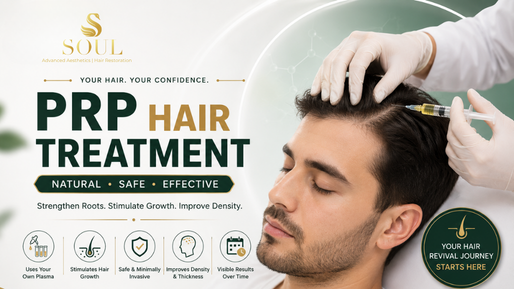
PRP hair treatment uses a concentrated portion of your own blood, known as platelet-rich plasma, which is prepared and administered into targeted areas of the scalp as part of a treatment plan for selected types of hair loss and thinning. PRP hair treatment may help support hair growth and improve hair density in suitable patients, particularly when active hair follicles are still present. However, results vary, and the right treatment depends on the cause, stage, and pattern of hair loss.
If you are experiencing thinning hair, increased shedding, reduced density, or early hair loss, PRP hair treatment should begin with a proper assessment rather than simply booking a procedure. Your hair-loss pattern, scalp health, existing hair density, medical history, and long-term goals can all influence whether PRP is suitable for you.
At Soul Aesthetic, people looking for PRP hair treatment in Andheri, Mumbai can explore a personalised approach based on their individual hair and scalp concerns. The focus is on understanding the reason behind the hair problem and recommending a suitable treatment plan with realistic expectations.
What Is PRP Hair Treatment?
PRP stands for platelet-rich plasma. PRP hair treatment involves taking a small sample of your own blood and processing it to separate and concentrate the platelet-rich portion. The prepared plasma is then administered into selected areas of the scalp.
Platelets contain substances involved in normal tissue repair and cell signalling. Researchers have studied PRP as a possible treatment for androgenetic alopecia, commonly known as pattern hair loss. Some studies suggest potential improvements in hair density, although PRP preparation methods, treatment schedules, and results vary significantly.
This variation is important. PRP hair treatment is not a one-size-fits-all procedure, and two people receiving PRP may not necessarily have the same treatment protocol or results.
How Does PRP Hair Treatment Work?
PRP hair treatment usually follows several steps:
1. Hair and Scalp Assessment
Before starting PRP hair treatment, the scalp and hair-loss pattern should be assessed. This step helps determine whether the person has pattern hair loss, temporary shedding, a scalp-related concern, or another possible cause.
The assessment can also consider how long the hair loss has been present, whether it is progressing, which areas are affected, and how much existing hair remains. This information helps determine whether PRP hair treatment may be appropriate or whether another treatment should be considered first.
2. Blood Collection
A small amount of your blood is collected, similar to a routine blood draw. Because PRP hair treatment uses your own blood, the platelet-rich component is prepared from your individual sample.
Your medical history and current medications should be discussed before the procedure because these factors may affect whether the treatment is appropriate.
3. PRP Preparation
The collected blood is processed to separate its components and concentrate the platelet-rich plasma.
Different clinics and studies may use different preparation systems. This is one of the reasons PRP hair treatment protocols can vary. The concentration of platelets, the preparation method, and the way PRP is administered may all differ.
4. PRP Administration Into the Scalp
After preparation, the PRP is administered into selected areas affected by thinning or reduced density.
The treatment areas are chosen according to your hair-loss pattern and the treatment plan. The procedure is designed to target areas where suitable hair follicles are still present and where PRP may form part of an overall hair-management strategy.
5. Follow-Up and Progress Monitoring
PRP hair treatment usually requires follow-up rather than judging the outcome immediately after one session.
Hair changes develop gradually. Comparing photographs, monitoring hair density, reviewing ongoing shedding, and attending follow-up consultations can provide a more realistic picture of progress over time.
Who May Consider PRP Hair Treatment?
PRP hair treatment may be considered for selected people experiencing hair thinning or certain forms of hair loss, especially when active follicles are still present.
Early Hair Thinning
People who notice early thinning may consider PRP hair treatment before hair loss becomes more advanced. Early intervention can be important because PRP is generally discussed as a treatment to support existing follicles rather than recreate follicles that are no longer active.
However, early thinning should still be evaluated properly. A receding hairline, diffuse thinning, or sudden shedding can have different causes and may require different treatment strategies.
Pattern Hair Loss
PRP hair treatment has been most commonly studied in people with androgenetic alopecia or pattern hair loss.
Men may notice gradual recession around the temples or thinning at the crown, while women may experience a widening hair part or diffuse reduction in hair density. A professional assessment can help determine whether PRP may be considered as part of a treatment plan for this type of hair loss.
Reduced Hair Density
Some people may not have obvious bald patches but may notice that their scalp has become increasingly visible or that their hair looks less dense than before.
In suitable cases, PRP hair treatment may be considered to support existing follicles and improve the overall appearance of density. The extent of improvement can vary based on follicle health, the stage of hair loss, and individual response.
People Looking for a Non-Surgical Option
PRP hair treatment does not involve surgically relocating hair follicles. For people who are not candidates for a hair transplant or who are dealing with earlier stages of thinning, PRP may be one option to discuss during a professional consultation.
However, non-surgical does not automatically mean suitable for everyone. The underlying cause of hair loss must still be identified.
For a broader understanding of available options, explore the Hair Treatments at Soul Aesthetic.
PRP Hair Treatment for Hair Fall
Hair fall can happen for many different reasons, including stress, illness, nutritional deficiencies, hormonal changes, scalp conditions, medications, and hereditary hair loss.
This is why PRP hair treatment should not automatically be presented as the answer to every person experiencing increased shedding.
For example, someone experiencing temporary shedding after illness may require a different approach from someone with progressive androgenetic alopecia. Similarly, sudden patchy hair loss or hair loss accompanied by scalp inflammation requires appropriate evaluation before any cosmetic procedure is considered.
A detailed assessment helps identify whether PRP hair treatment may have a role in the treatment plan or whether another approach should take priority.
If you are experiencing excessive shedding, you can also explore Hair Fall Treatment at Soul Aesthetic.
PRP Hair Treatment and Hair Regrowth
PRP hair treatment is often discussed for its potential to support existing hair follicles. Research suggests that PRP may improve hair density in some people with androgenetic alopecia, but results vary because studies use different preparation methods, injection techniques, and treatment schedules.
This means PRP hair treatment should not be marketed as a guaranteed method to regrow hair in every bald or thinning area.
The response can depend on several factors:
- How long the hair loss has been present
- Whether active follicles remain
- The cause of hair loss
- The stage of thinning
- Your overall scalp health
- The PRP protocol used
- Whether other treatments are part of the plan
- Individual biological response
For people concerned about thinning and reduced density, Hair Regrowth Treatment may provide additional information about treatment approaches available at Soul Aesthetic.
What Happens During a PRP Hair Treatment Session?
A PRP hair treatment session generally begins with reviewing your scalp and treatment plan.
A small blood sample is collected and processed to prepare the platelet-rich plasma. Once the PRP is ready, the treatment areas on the scalp are identified, and the PRP is administered according to the planned protocol.
The American Academy of Dermatology describes PRP treatment for hair loss as involving blood collection, separation of blood components, and injection of the plasma portion into areas affected by hair loss.
The exact duration of the appointment can vary based on the clinic protocol and treatment area.
After the procedure, you may receive specific aftercare instructions. Following these instructions is important because recommendations about hair washing, exercise, scalp products, and other activities may differ depending on the treatment protocol.
How Many PRP Hair Treatment Sessions Are Needed?
There is no single number of PRP hair treatment sessions that is suitable for every patient.
Some treatment protocols recommend an initial series of sessions followed by maintenance, while the exact schedule can depend on the type of hair loss, treatment response, and clinical approach.
Instead of choosing a clinic based only on a large package of sessions, it is useful to ask:
- Why are these sessions recommended?
- What type of hair loss am I being treated for?
- How will progress be measured?
- When should results realistically be assessed?
- Will maintenance treatment be required?
- Should PRP hair treatment be combined with another treatment?
A personalised treatment schedule should have a clear reason behind it rather than simply following the same package for every patient.
Benefits of PRP Hair Treatment
PRP hair treatment may offer several potential benefits for suitable candidates. However, the benefits depend on the type and stage of hair loss, the condition of existing follicles, and individual response.
1. Uses Your Own Blood
One of the key features of PRP hair treatment is that the platelet-rich plasma is prepared from your own blood.
This autologous approach means that no donor material is required for the PRP itself. However, using your own blood does not eliminate the need for proper medical screening, sterile technique, and professional administration.
A qualified professional should still review your medical history and determine whether the procedure is appropriate for you.
2. May Support Existing Hair Follicles
PRP hair treatment may be particularly relevant for people who still have active hair follicles but are experiencing thinning or reduced density.
Research has shown potential improvements in hair density for some people with androgenetic alopecia. However, the degree of improvement varies, and PRP should not be described as a guaranteed way to restore a completely bald area.
The condition of the follicles at the start of treatment can influence what results may realistically be expected.
3. May Help Improve the Appearance of Hair Density
For suitable patients, gradual improvement in hair density may help reduce the visibility of the scalp and create a fuller-looking appearance.
The goal is usually not an overnight transformation. Hair changes occur gradually, and visible improvement, when it occurs, should be assessed over time.
Taking standardised photographs before and during treatment can help track changes more accurately than relying only on daily visual impressions.
4. Can Form Part of a Personalised Treatment Plan
PRP hair treatment does not always need to be viewed as an isolated procedure.
Depending on the diagnosis, it may form one part of a broader approach that also addresses ongoing hair fall, scalp health, hair regrowth goals, or long-term hair restoration planning.
The benefit of a personalised plan is that treatment can focus on the actual problem rather than assuming every patient requires the same procedure.
5. Does Not Require Surgical Hair Relocation
Unlike a hair transplant, PRP hair treatment does not involve removing hair follicles from a donor area and surgically implanting them elsewhere.
This may make it an option to discuss for people with early thinning or those who are not currently considering a surgical procedure.
However, PRP hair treatment and hair transplantation address hair loss differently, so suitability depends on the individual’s condition.
6. Usually Involves Minimal Downtime
PRP hair treatment is generally performed as an outpatient procedure, and the American Academy of Dermatology notes that PRP treatment for hair loss typically does not require downtime.
Even so, you may experience temporary tenderness, redness, or sensitivity. Your treating professional should provide clear aftercare guidance based on your specific procedure and scalp condition.
PRP Hair Treatment for Men and Women
PRP hair treatment may be considered for both men and women, but the pattern and cause of hair loss can differ.
PRP Hair Treatment for Men
Men commonly experience a receding hairline, thinning at the temples, or reduced density around the crown. These changes may develop gradually due to androgenetic alopecia.
PRP hair treatment may be considered when suitable follicles are still present. However, if hair loss has progressed significantly and the affected area has very limited active follicle activity, another treatment approach may be more appropriate.
PRP Hair Treatment for Women
Women may experience diffuse thinning, reduced volume, or a widening hair part.
Because several factors can contribute to hair loss in women, including hormonal changes, nutritional deficiencies, stress, and medical conditions, identifying the cause is particularly important before starting PRP hair treatment.
A personalised assessment can help determine whether PRP is suitable or whether another underlying issue should be addressed first.
PRP Hair Treatment and Scalp Health
Healthy hair growth depends on more than the visible hair strands. The condition of the scalp can also influence a person’s overall hair concerns.
If you experience persistent itching, excessive scaling, redness, irritation, or inflammation, these issues should be assessed instead of simply proceeding with PRP hair treatment.
A scalp problem may require specific management before or alongside a hair-growth treatment plan. Ignoring an underlying scalp condition can mean that the visible symptom—hair thinning—is treated without addressing a possible contributing factor.
You can explore Scalp Treatment at Soul Aesthetic for more information about scalp-focused care.
How Long Does PRP Hair Treatment Take to Show Results?
PRP hair treatment does not create immediate visible hair growth. Hair grows through a natural biological cycle, so changes develop gradually.
The timeline can depend on:
- The cause and stage of hair loss
- The condition of existing follicles
- The treatment schedule
- Individual response
- Whether other treatments are being used
- Consistency with the overall treatment plan
Some people may first notice changes in hair shedding or hair quality before noticing visible improvements in density. Others may require more time before any change becomes noticeable.
A professional consultation should explain when progress can realistically be assessed instead of promising a fixed timeline for every patient.
Is PRP Hair Treatment Permanent?
PRP hair treatment is not considered a permanent cure for progressive hair loss.
If you have hereditary or androgenetic hair loss, the underlying tendency toward progressive thinning may continue to affect existing, non-transplanted hair.
For this reason, some people may require maintenance treatment or another long-term management approach. The need for maintenance depends on the diagnosis, response to treatment, and overall treatment goals.
A realistic discussion before PRP hair treatment should include not only potential improvements but also what may happen if treatment stops.
PRP Hair Treatment vs Hair Transplant
PRP hair treatment and hair transplantation serve different purposes.
PRP Hair Treatment
PRP hair treatment may be considered when active follicles remain but are producing thinner or less dense hair.
The goal may be to support existing follicles and improve the appearance of density in suitable candidates.
Hair Transplant
A hair transplant involves relocating healthy follicles from a donor area to areas affected by permanent hair loss or significant thinning.
It may be considered for selected candidates with suitable donor hair and a stable, appropriately assessed hair-loss pattern.
Which One Is Better?
Neither treatment is universally better.
Someone with early thinning and active follicles may benefit from a non-surgical treatment approach, while someone with advanced hair loss may require a different strategy.
Your donor hair, scalp condition, existing follicle activity, pattern of hair loss, age, future hair-loss risk, and long-term goals all matter.
To understand when surgical restoration may be considered, explore Hair Transplant options at Soul Aesthetic.
Who May Not Be a Suitable Candidate for PRP Hair Treatment?
PRP hair treatment should not automatically be recommended to every person with hair loss.
A professional assessment is especially important if you have:
- Sudden hair loss: Sudden or rapid shedding can sometimes indicate an underlying trigger that needs to be identified before cosmetic treatment begins.
- Patchy hair loss: Distinct bald patches can have different causes, including autoimmune or inflammatory conditions, and may require specific medical evaluation.
- Active scalp infection or inflammation: Treating an underlying scalp issue should take priority when the scalp shows signs of infection, significant irritation, or inflammation.
- Advanced hair loss: If an area has very limited active follicle activity, PRP hair treatment may not provide the level of improvement you expect.
- Certain medical conditions: Your overall health, blood-related conditions, medications, and medical history can influence whether PRP is appropriate.
An honest assessment should explain when PRP hair treatment is unlikely to provide meaningful results instead of recommending it to every person who walks into the clinic.
Possible Side Effects of PRP Hair Treatment
PRP hair treatment generally has a favourable safety profile because the platelet-rich plasma comes from the patient’s own blood. However, no procedure is completely free from potential side effects.
Temporary Pain or Discomfort
Because PRP is administered into the scalp, you may experience discomfort during or shortly after the procedure.
The level of discomfort can vary depending on individual sensitivity and the treatment technique.
Tenderness and Scalp Sensitivity
The treated area may feel tender or sensitive for a short period.
This is usually temporary, but you should follow the aftercare instructions provided by your treating professional.
Mild Swelling or Redness
Some people may experience temporary redness or mild swelling around the treatment area.
If symptoms are severe, unusual, or continue longer than expected, you should contact your treating clinic for guidance.
Other Potential Risks
As with any procedure involving blood collection and scalp injections, appropriate hygiene, sterile technique, patient screening, and professional administration are important.
A consultation should include a discussion of potential risks and side effects based on your individual health and treatment plan.
Why Professional Assessment Matters Before PRP Hair Treatment
Hair loss is a symptom, not always a diagnosis.
Two people may both complain of thinning hair but have completely different causes. One may have hereditary hair loss, while another may have temporary shedding caused by illness, nutritional issues, stress, medication, or a scalp condition.
A proper assessment before PRP hair treatment may consider:
- Hair-loss pattern: The areas affected can provide important information about the possible cause and progression of hair loss.
- Duration of hair loss: Recent shedding may require a different approach from gradual thinning that has developed over several years.
- Existing hair density: The amount and condition of remaining hair can influence whether PRP hair treatment is likely to be useful.
- Scalp condition: Redness, inflammation, scaling, or other scalp concerns may need attention before focusing only on hair growth.
- Medical and family history: Your personal health history and family pattern of hair loss can provide useful context.
- Long-term goals: Some people want to slow further thinning, while others are concerned about visible density or future restoration options.
At Soul Aesthetic, this type of assessment supports a more personalised approach instead of offering the same PRP hair treatment plan to every patient.
You can learn more about the clinic through About Soul Aesthetic.
Why People Consider Soul Aesthetic for PRP Hair Treatment
Choosing a clinic for PRP hair treatment in Andheri, Mumbai should involve more than comparing the cost of a single session or choosing the largest treatment package.
People may consider Soul Aesthetic based on the following factors:
- Individual assessment: The first step is understanding the pattern and possible cause of your hair loss. This helps determine whether PRP hair treatment is appropriate or whether another approach should be considered before starting the procedure.
- Personalised treatment planning: Every person has different hair density, scalp conditions, hair-loss patterns, and long-term goals. A personalised plan can consider these differences instead of automatically recommending the same number of PRP sessions to everyone.
- Focus on realistic expectations: PRP hair treatment may support hair density in suitable patients, but results can vary. Understanding the possible benefits and limitations before treatment can help prevent unrealistic expectations.
- Attention to scalp health: Hair thinning may exist alongside scalp concerns such as irritation, inflammation, or excessive scaling. Addressing these concerns can be an important part of an overall hair-care strategy.
- Multiple treatment pathways: PRP may be one option, but it is not the only option for every type of hair loss. Depending on the assessment, a patient may need hair fall management, scalp-focused care, hair regrowth treatment, or long-term restoration planning.
- Long-term approach: Progressive hair loss can continue over time. A good treatment strategy should therefore consider not only current hair density but also future hair-loss patterns and the need for ongoing management.
- Professional guidance and follow-up: Clear guidance before and after PRP hair treatment can help patients understand the procedure, follow aftercare instructions, monitor changes, and discuss their progress during follow-up appointments.
Conclusion
PRP hair treatment may be a useful option for selected people with certain types of hair thinning, particularly when active hair follicles are still present. Research suggests that PRP may improve hair density in some people with androgenetic alopecia, but treatment protocols and individual outcomes can vary. PRP hair treatment should therefore not be promoted as a guaranteed cure for every type or stage of hair loss.
The most important step is understanding why your hair loss is happening. Your pattern of thinning, scalp health, existing hair density, medical history, and long-term goals can all influence whether PRP hair treatment is suitable.
If you are looking for PRP hair treatment in Andheri, Mumbai, a professional consultation at Soul Aesthetic can help you understand your concerns and explore an appropriate treatment approach.
To discuss your hair-loss concerns and available options, Contact Soul Aesthetic for a professional consultation.
FAQs
Q1. Does PRP hair treatment regrow hair?
Ans. PRP hair treatment may support hair density and growth in some suitable patients, particularly those with certain forms of pattern hair loss. However, results vary and cannot be guaranteed.
Q2. How many PRP hair treatment sessions are needed?
Ans. The number of sessions depends on your hair-loss pattern, treatment response, and clinical plan. Some people may also require maintenance sessions over time.
Q3. Is PRP hair treatment painful?
Ans. You may experience some discomfort because PRP is administered into the scalp. Temporary tenderness or sensitivity can also occur after the procedure.
Q4. Is PRP hair treatment permanent?
Ans. No. PRP hair treatment is not considered a permanent cure for progressive hair loss. Some people may require ongoing management or maintenance depending on their condition.
Q5. Can PRP hair treatment stop hair loss?
Ans. PRP hair treatment may help selected patients, but it cannot guarantee that all hair loss will stop. The outcome depends on the underlying cause and individual response.
Q6. Is PRP hair treatment better than a hair transplant?
Ans. Neither option is universally better. PRP hair treatment may be considered when active follicles remain, while a hair transplant may be suitable for selected candidates with permanent hair loss and adequate donor hair.